
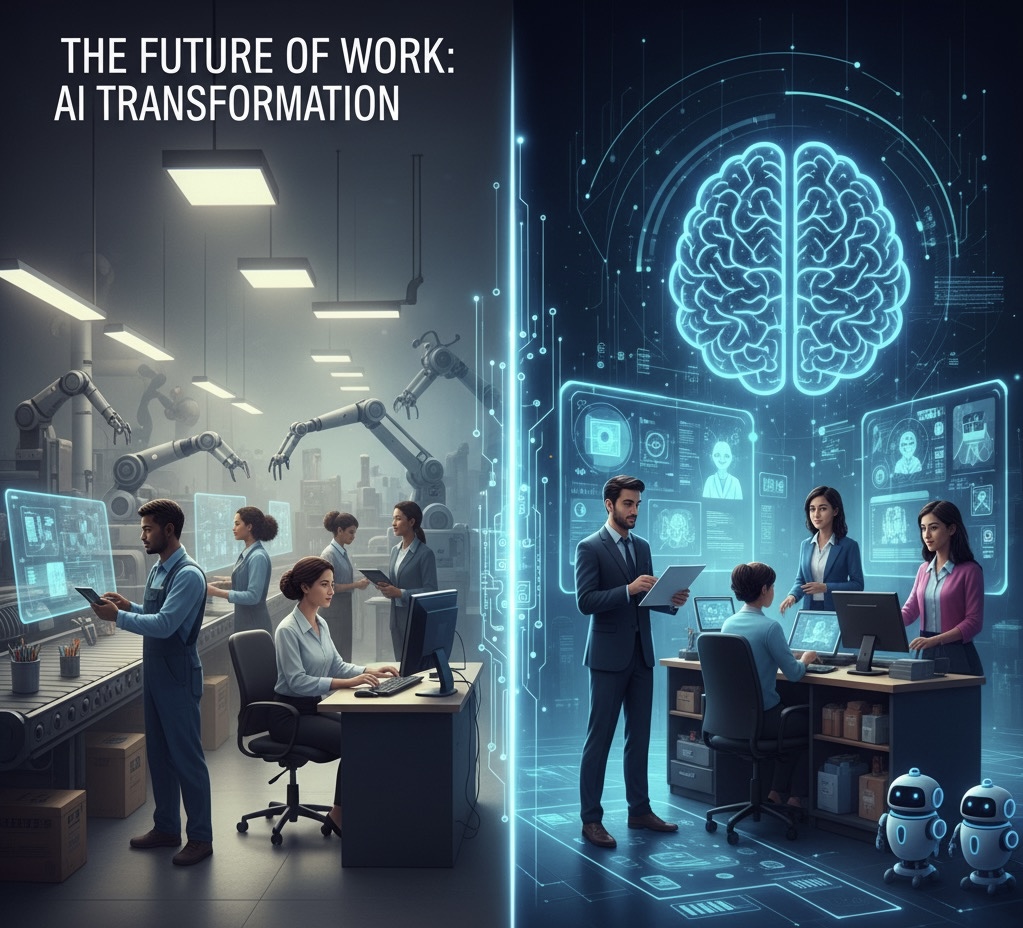
How AI Is Transforming the World of Work in 2025
Explore how AI in 2025 is transforming workplaces, reshaping jobs, boosting productivity, and creating new career opportunities globally.
Keywords: AI in the workplace, future of work 2025, artificial intelligence jobs, AI productivity tools, AI job trends
Introduction
Artificial Intelligence (AI) in 2025 is no longer an experimental technology; it has become a core driver of workplace transformation across every sector. From finance and healthcare to manufacturing and creative industries, AI is automating repetitive tasks, augmenting decision-making, and unlocking new ways of working. For businesses, it means greater efficiency and innovation. For workers, it presents both opportunities and the need for reskilling.
1. AI as a Productivity Engine
AI tools have moved far beyond simple chatbots or scheduling assistants. In 2025, advanced AI systems can draft contracts, analyze massive datasets in seconds, and generate multimedia content tailored to specific audiences. Employees are using AI co-pilots to speed up email writing, code development, marketing campaigns, and even legal research. This shift reduces the time spent on routine tasks, allowing professionals to focus on creative and strategic work.
2. Human–AI Collaboration
Rather than replacing humans outright, the most successful workplaces in 2025 are those blending human creativity with AI’s analytical power. Managers use AI to predict market trends or detect inefficiencies, while employees leverage it for personalized learning and upskilling. AI-driven dashboards provide real-time feedback on performance, helping teams adapt faster and make data-backed decisions.
3. Job Transformation, Not Just Automation
While some low-skill or repetitive roles are automated, AI is also creating entirely new job categories. Roles like “AI trainer,” “prompt engineer,” and “AI ethics auditor” are now in high demand. In Indonesia, for instance, local-language AI models have opened opportunities for linguists, data curators, and regional AI specialists. This evolution highlights the importance of lifelong learning and digital literacy in the workforce.
4. AI and Remote Work
AI-powered collaboration platforms are making hybrid and remote work smoother than ever. Automatic meeting summarizers, real-time translation tools, and AI-driven project management systems help globally distributed teams work as if they’re in the same office. This has expanded hiring possibilities and allowed companies to tap into a truly global talent pool.
5. Challenges in the AI Workplace
Despite the benefits, the rapid adoption of AI raises concerns over data privacy, algorithmic bias, and job displacement. Organizations must implement transparent AI policies and offer retraining programs. Governments are introducing AI workforce regulations to protect workers’ rights and ensure fair use of AI systems.
Conclusion
AI in the workplace is not a passing trend but a fundamental reshaping of how work gets done. By embracing AI as a collaborator rather than a competitor, organizations can unlock massive productivity gains while empowering employees to do more meaningful work. For individuals, the key to thriving in the AI-powered workplace of 2025 is continuous upskilling, adaptability, and a willingness to work hand-in-hand with technology.